








By Shreekant Dhopte, Chief Operating Officer, Excelize. Last updated October 2026.
If you run production at a U.S. architecture firm, the 2D CAD drafting vs 3D CAD modeling question isn’t academic. It decides how many hours a late design change costs you, how often a sheet goes out wrong, and how much of your senior team’s week disappears into redlines.
Here’s the short answer. 2D CAD drafting builds every plan, section, and elevation as separate line work, so each change is redrawn everywhere it appears. 3D CAD modeling builds the building once and cuts views from it, so changes carry through. Draft in 2D for small, stable scopes. Model in 3D when the design will keep moving or disciplines must fit together.
What’s actually different between 2D drafting and 3D modeling?
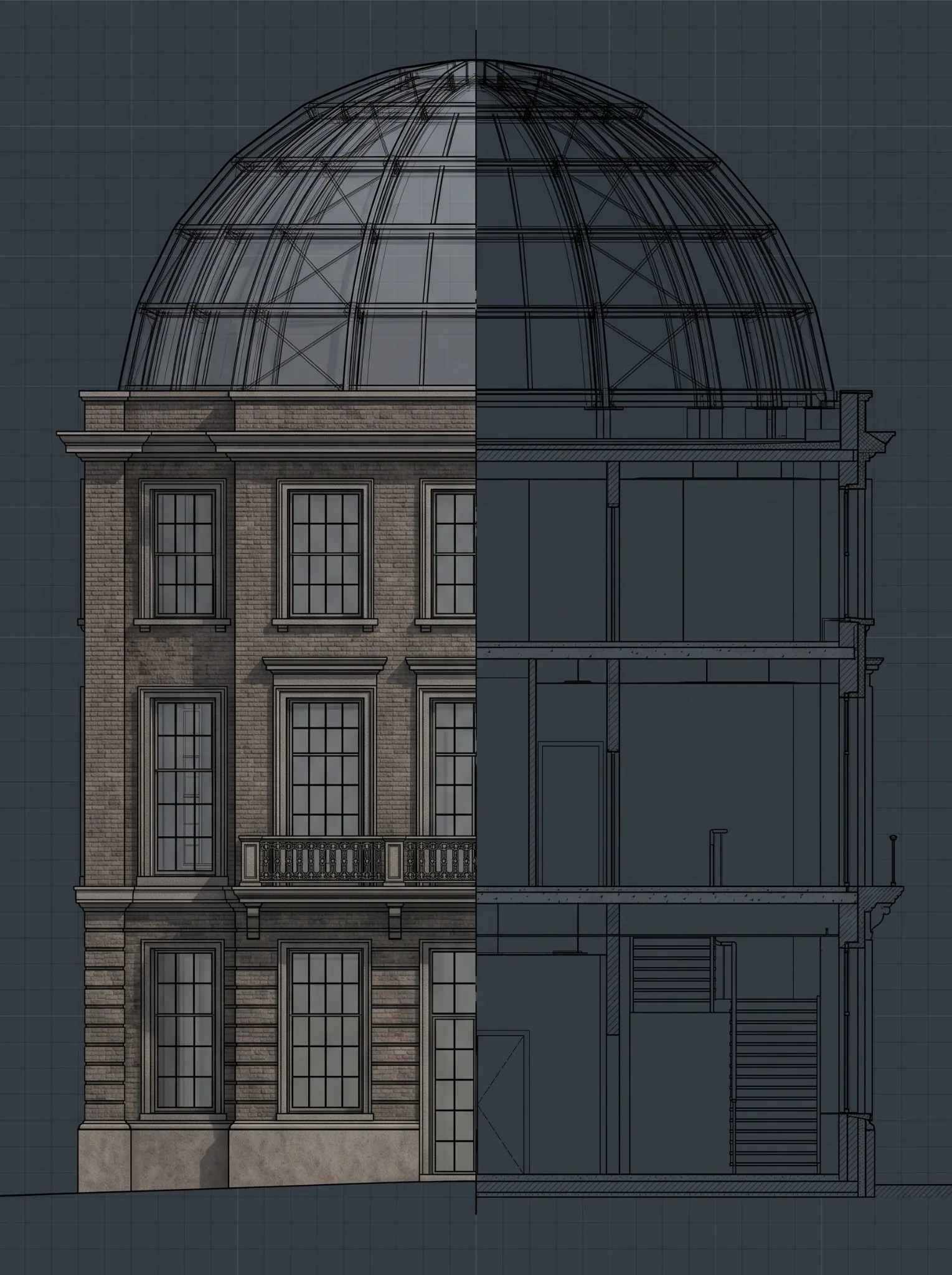
In 2D drafting, a wall is two parallel lines on a floor plan. Somewhere else in the set, that same wall is a pair of lines on a section and a hatch on an elevation. None of those drawings knows about the others. Your drafter is the only thing keeping them consistent.
In 3D modeling, you build the wall once as geometry with real thickness and height. Plans, sections, and elevations become views of that one object. Move it, and every view moves with it.
That difference shows up in three places:
- Revisions: In 2D, one change means hunting down every sheet it touches. In 3D, the change happens once.
- Consistency: In 2D, the plan and the section can quietly disagree. In 3D, they’re cut from the same geometry.
- Coordination: In 2D, you overlay drawings and hope you spot the conflict. In 3D, you can see it, and with the right tools, test for it.
Solid models and surface models
Not all 3D geometry behaves the same way. Autodesk’s AutoCAD documentation on 3D modeling says solid modeling “offers mass properties and sectioning capabilities,” while surface modeling gives fine control over curved shapes. For building work, that matters. Solids can be cut into sections and measured, which is what construction documents need. Surfaces suit complex curved forms, such as a feature façade or canopy, where shape control matters more than volume.
Where BIM fits in
A 3D CAD model is geometry. A BIM model attaches information to that geometry: what each element is, what it’s made of, and how it relates to everything around it. If you’re weighing that bigger shift, our breakdown of BIM vs CAD covers it in depth. This article stays on the production question: drawing lines versus building a model.
CTA: Not sure which of your current projects would gain from a model? Send us one of your CAD sheets, and we’ll model it in Revit to your standards so you can compare the two side by side.
Button: See Your CAD Sheet as a 3D Revit Model
2D CAD drafting vs 3D CAD modeling at a glance
| Criterion | 2D CAD drafting | 3D CAD modeling |
| What you create | Separate drawings made of lines, arcs, hatches, and text | One model, with drawings as views of it |
| How views are produced | Each plan, section, and elevation drawn individually | Views generated from the model, then annotated |
| Cost of a design change | Grows with every sheet the change touches | Change the model once, then check the views |
| Risk of sheets disagreeing | High on large sets | Low, because views share the same geometry |
| Spatial coordination | Visual overlay of drawings | 3D review, plus clash testing when models are federated |
| Quantities | Counted or measured by hand | Extracted from the model, as accurate as the modeling |
| Learning curve | Short | Longer, and needs templates and standards |
| Hardware | Runs on most workstations | Needs more memory and graphics power on large models |
| Common formats | DWG, DXF, PDF | RVT, IFC, NWC, plus DWG and PDF exports |
| Best fit | Small tenant improvements, standard details, quick sketches | Multistory, multi-discipline, or revision-heavy projects |
When is 2D drafting still the right call?
2D drafting is still the right call for small, stable scopes where a model’s setup time won’t pay back. Pretending otherwise wastes fee. Here’s where 2D usually wins:
- Small, stable scopes: A minor tenant improvement with a handful of sheets and little design churn rarely repays the effort of building a model.
- Standard details: Typical wall sections, door details, and code diagrams are often quicker to draft and reuse in 2D.
- Existing DWG backgrounds: When an owner or consultant hands you DWG backgrounds and the scope won’t grow, working in their format can be the practical choice.
- Field sketches: Quick 2D sketches still move fastest on site and in RFI responses.
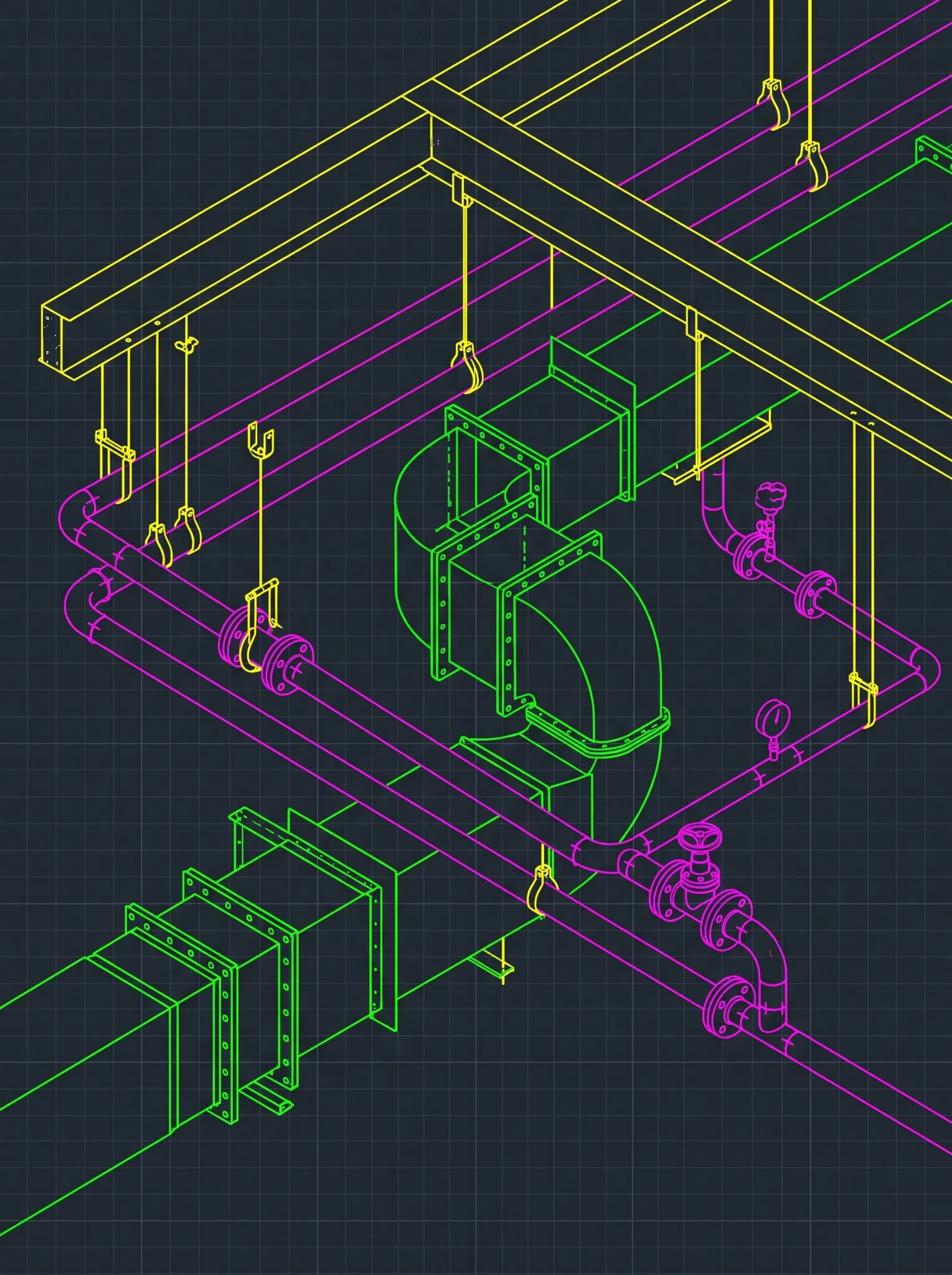
Even on fully modeled projects, the document most people sign is still a 2D sheet. That’s normal, and it’s not a contradiction. Trade sign-off is a good example: we produce 2D coordination drawings generated from the federated model so every trade signs off on sheets that match the coordinated geometry.
When does 3D modeling pay for itself?
3D modeling pays for itself when the design keeps changing or many people depend on the same information. That’s most mid-size and large commercial work.
- Revision-heavy phases: Design development is where 2D sets fall out of sync. A model absorbs changes without redrafting every view.
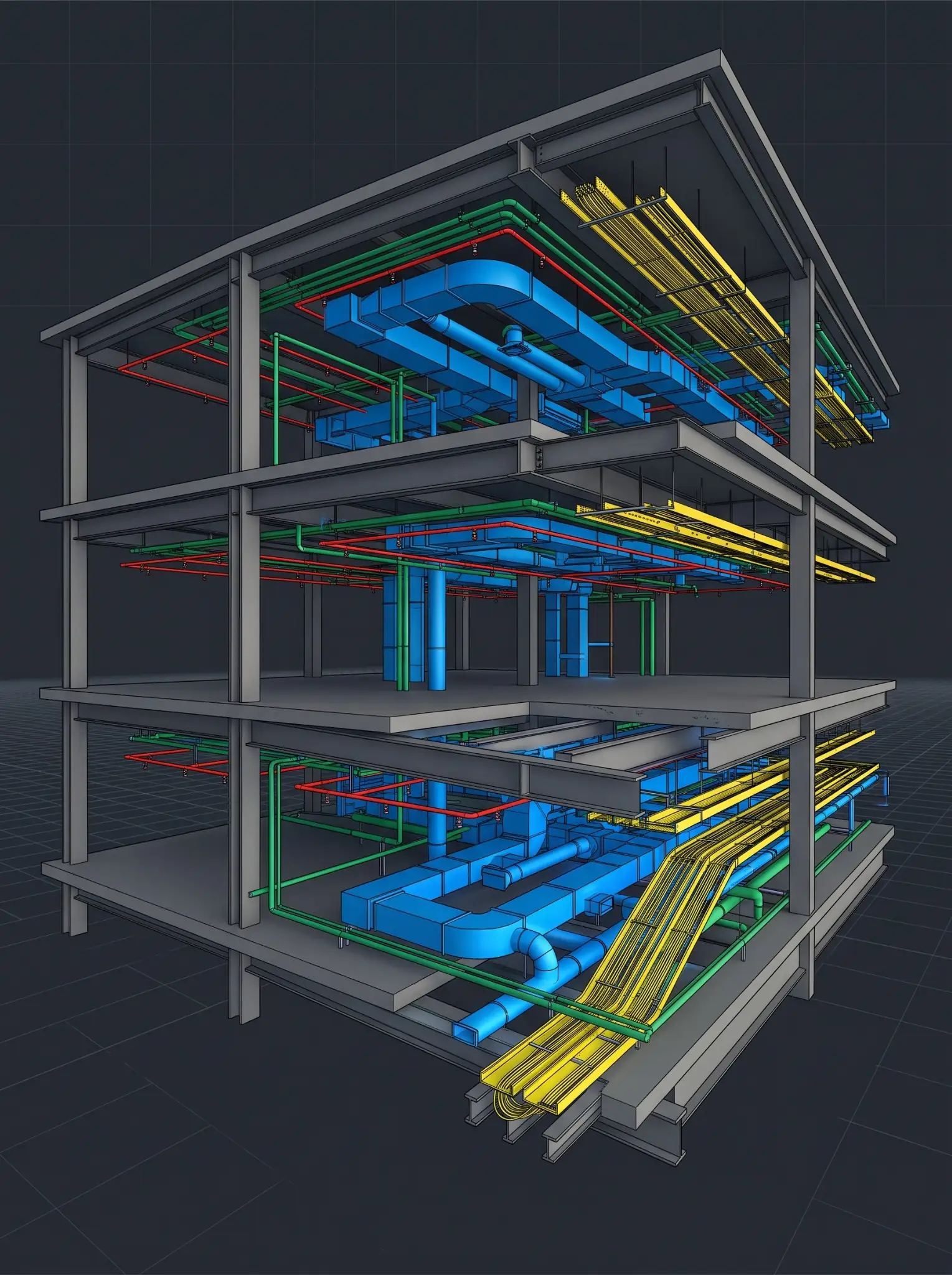
- Multi-discipline buildings: Healthcare, labs, and mixed-use projects pack architecture, structure, and MEPF systems into tight space. Seeing them together in 3D surfaces conflicts that overlaid sheets can hide.
- Repetition: Multifamily unit types and repeated floors are built once and reused, not redrawn.
- Quantities: A well-built model gives your estimator counts and areas without a separate takeoff.
The research points the same way. In Dodge Data & Analytics’ 2021 SmartMarket Report on BIM, 73% of the heaviest BIM users (those using it on 75% or more of their projects) reported reduced errors and rework, compared with 52% of the lightest users. The survey covered BIM users across seven regions, including North America, so read it as evidence about depth of use rather than a U.S.-only figure.
What “LOD 300” means for your drawings
When a model is meant to carry your construction documents, the usual target is LOD 300. The BIMForum 2025 LOD Specification describes LOD 300 elements as 3D and “sufficiently developed to fully convey the design intent.” It also leaves the LOD for each phase to the project team, which is why your BIM Execution Plan should state it before modeling starts.
What this looks like on a real project
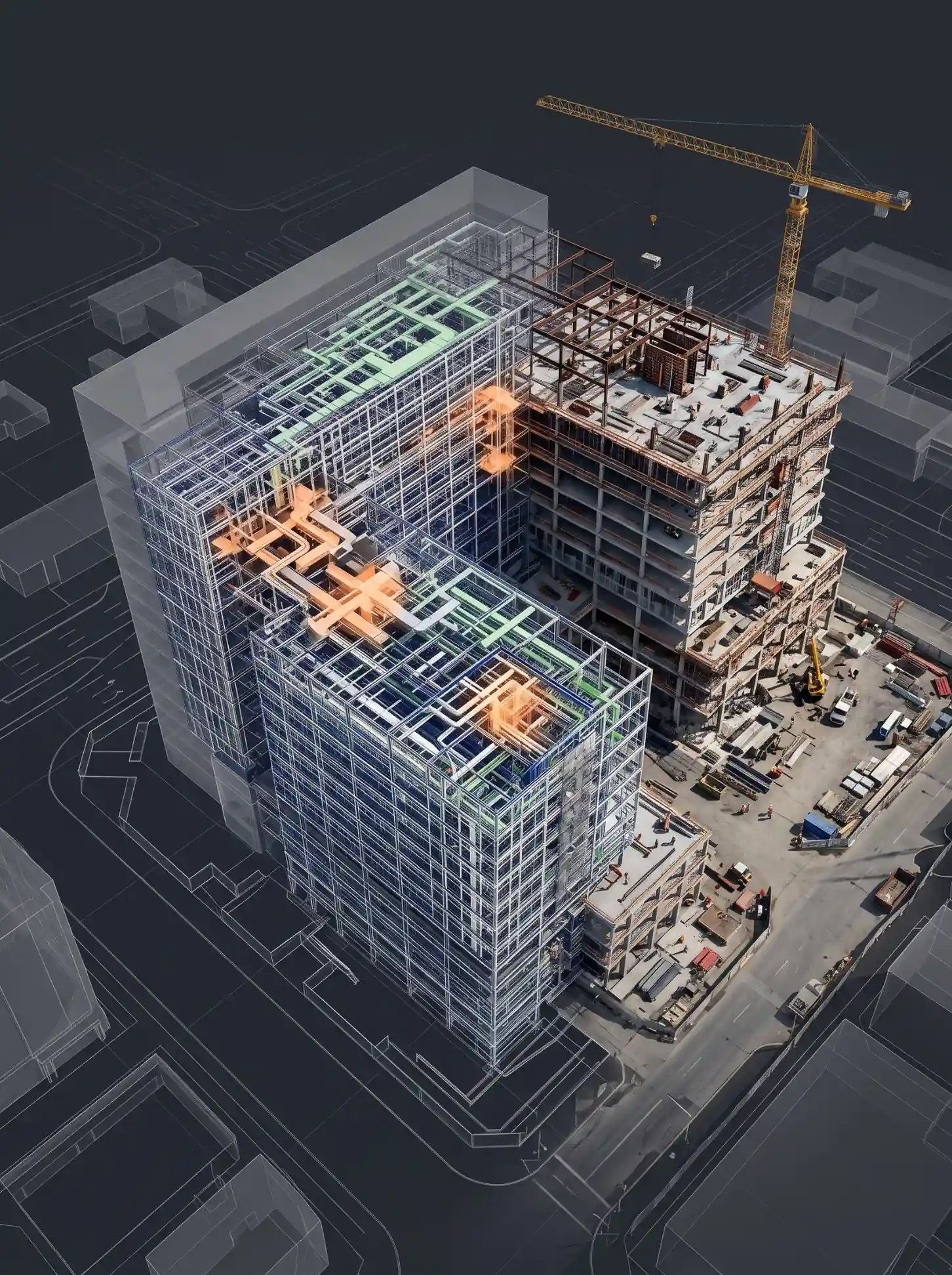
On the Stockton North Tower hospital project, a 250,600 sq. ft. U.S. healthcare build, Excelize developed the structural BIM model at LOD 300 through repeated design revisions. Design development drawings were extracted directly from the updated model, and every delivery went through QA/QC’d review for model and drawing consistency. The client’s starting problem was the classic 2D one: drawings and design information drifting apart each time the design changed.
The real question: who’s doing the production?
For most firms, deciding to model isn’t the hard part. Finding the hours is. The U.S. Bureau of Labor Statistics projects drafter employment to grow just 1% from 2025 to 2035, slower than average, and expects wider use of CAD and BIM to reduce demand for many types of drafters. Production is shifting from line drafting to modeling, and you need people who can model to your standards.
Ask these five questions before you move a project, or your whole CD workflow, from 2D to 3D:
- How much design change do we expect after schematic design?
- How many disciplines have to share the same ceiling space or shafts?
- Does the owner, GC, or BIM Execution Plan require a model deliverable?
- Do we already have Revit templates, families, and standards, or do we need to build them?
- Who will do the modeling, and can they start before the next deadline?
If the answers to the first three are “a lot,” “three or more,” and “yes,” the project wants a model. Questions 4 and 5 decide whether you build it in-house or bring in an extended team.
Converting an existing 2D CAD set into a 3D Revit model is the most common starting point. Our 3D BIM modeling services team works inside your Revit templates and standards, with project leads in New Jersey and California and production in our BIM delivery studio in India. A modeler or pod can be embedded within 48 hours. If you’re comparing costs, our guide to how Revit production work is priced in the U.S. breaks down hourly, per-sheet, and dedicated-team pricing.
CTA: Deciding whether to move CD production from AutoCAD to Revit this year? We’ll walk through your next project’s scope, LOD, and timeline with you, and tell you honestly whether a model is worth it.
Button: Plan Your AutoCAD to Revit Transition
What does your contract say the deliverable is?
On many U.S. projects, the signed 2D sheets remain the legal record, even when the work was produced in 3D. Under the AIA’s 2022 digital practice documents, the BIM exhibit you choose decides whether a model can be a formal contract document. According to AIA Contract Documents’ guidance on E202-2022, E201-2022 permits model versions to be enumerated as a Contract Document, while E202-2022 does not.
So your model and your sheets have to agree. That’s one more reason to cut the sheets from the model instead of drawing them separately.
Frequently asked questions
Is 2D CAD drafting still used in construction?
Yes. 2D drafting is still common for small scopes, standard details, and field sketches, and nearly every project still issues 2D sheets. What’s changed is where those sheets come from. On larger projects, they’re increasingly cut from a 3D model instead of drawn line by line.
Is 3D modeling always better than 2D drafting?
No. On a small, stable scope, a 3D model can cost more setup time than it saves. 3D modeling pays off when the design changes often, disciplines must coordinate in tight space, or quantities need to come straight from the model.
Can you get 2D drawings from a 3D model?
Yes. In modeling tools such as Revit, plans, sections, and elevations are views of the model, placed on sheets and annotated. When the model changes, those views update, though tags and notes still need a check before you issue the set.
Is a 3D CAD model the same as BIM?
Not quite. A 3D CAD model holds geometry. A BIM model attaches information to that geometry, such as materials, element types, and relationships between elements. A good BIM model gives you everything a 3D CAD model does, plus data you can schedule and coordinate.
How long does it take to convert 2D CAD drawings to a 3D Revit model?
It depends on the size of the set, the target LOD, and how complete the drawings are. As a starting point, Excelize will model a sample in Revit to your standards in 2 to 3 days, so you can judge quality and pace before committing a full set.